An indoor hydroponic garden is worth buying if you want fresh herbs or lettuce year-round and can commit to 15–30 minutes of weekly maintenance. It won't cut your grocery bill — but it will earn its counter space through the experience of growing something.
How indoor hydroponics works
Hydroponics removes soil from the growing equation. Roots grow in an inert medium — water, rockwool, or expanded clay pellets — and receive nutrients directly through a liquid solution. Plants have constant access to water, oxygen, and minerals without competing with soil for any of them.
Indoors, this pairs with full-spectrum LED lighting to replace sunlight. The result: faster growing cycles, significantly less water than traditional gardening, and the ability to grow year-round regardless of climate.
System types: which one to choose
Kratky is the simplest approach. Plants are suspended above a reservoir of nutrient solution with no pump required. Works well for lettuces and fast-growing herbs. Low maintenance, but doesn't scale well to larger plants.
DWC (Deep Water Culture) adds constant oxygenation through an air pump. Roots are permanently submerged in well-oxygenated nutrient solution. Faster than Kratky for many plants; requires continuous electricity for the air pump.
NFT (Nutrient Film Technique) circulates a thin film of nutrient solution through sloped channels where roots grow. Efficient in space and water use. More complex to set up; if the pump fails, plants dry out quickly.
Compact home systems are usually simplified variants of Kratky or DWC — a closed container with a built-in light and timer.
What grows well (and what doesn't)
Grows well indoors with hydroponics:
- Leafy greens (lettuce, spinach, arugula, kale): 3–6 week cycles, tolerant of artificial light.
- Culinary herbs: basil, cilantro, parsley, mint — moderate light demand.
- Microgreens: ready in 7–14 days, high yield per square foot.
- Strawberries: more demanding but viable in well-designed systems.
Harder or impractical:
- Tomatoes and peppers: need intense light (14–16 h/day with powerful LEDs), physical support, and manual pollination. Doable, but complex to manage well at home.
- Root vegetables (carrots, radishes): the edible root needs a solid growing medium, which complicates the design of most home systems.
- Fruit trees: outside the practical scope of any domestic indoor system.
What you need to know about LED lighting
Modern full-spectrum LEDs consume far less than the discharge lamps used a decade ago, but electricity use is still worth factoring in.
Practical reference points:
- Herbs and lettuce: 20–40 W per square foot of growing area, 14–16 hours per day.
- Strawberries and small fruiting plants: 30–50 W per square foot, 16–18 hours.
Compact home systems (roughly 1–2 square feet of growing area) typically draw 20–80 W total — comparable to running one or two energy-efficient bulbs almost all day.
Weekly maintenance
An indoor hydroponic garden isn't maintenance-free. Budget 15–30 minutes per week for:
Water level. Nutrient solution evaporates and plants absorb it. Top off with plain water (no nutrients) when levels drop, or with diluted solution if more than 10 days have passed since the last full mix.
pH. The optimal range for most plants is 5.5–6.5. Outside that range, plants can't absorb certain nutrients even if those nutrients are present in the solution. A basic pH meter and pH up/down solutions are essential tools — not optional.
Nutrients. Every 2–3 weeks, drain the reservoir completely and mix a fresh solution to prevent mineral salt buildup.
Algae control. Any part of the system exposed to light can develop green algae. Algae isn't lethal but competes for nutrients and oxygen. Cover reservoirs and any surfaces where light might reach the solution.
Common first-year mistakes
Over-fertilizing. Commercial nutrient solutions are formulated for professional growing environments. For small home systems, start at half the recommended dose and adjust based on how plants look — yellowing tips usually mean too much, pale leaves often mean too little.
Ignoring pH. Plants can look fine for weeks with pH outside the ideal range and then suddenly show nutrient deficiency symptoms that seem inexplicable. Measuring pH is the step most beginners skip and the one that causes the most problems.
Algae in the reservoir. Cause: light reaching the solution. Fix: cover everything that can be covered. Dark-colored reservoirs or opaque covers work; duct tape over clear lids also works.
Production expectations. A 2×2 ft system can realistically produce enough lettuce for a side salad every week or two — not a full grocery replacement. That's not a flaw; it's the honest scale of a home setup.
Is it worth it?
It depends on what you're after. If the goal is saving money on vegetables, the economics rarely work out for small home systems — electricity, nutrients, and equipment usually cost more than the produce is worth at market prices.
If the goal is learning how it works, having fresh herbs within reach, or simply the process of growing something — it's absolutely worth it. Indoor hydroponic gardens are one of the few gadgets that earn their counter space through the experience they provide, not just their output.
Our picks
We checked each of these against each maker's own product pages — pod capacity, real wattage, water-tank size, and what the pod system actually locks you into. Grouped by size, not by price.
Compact — 3-pod countertop garden
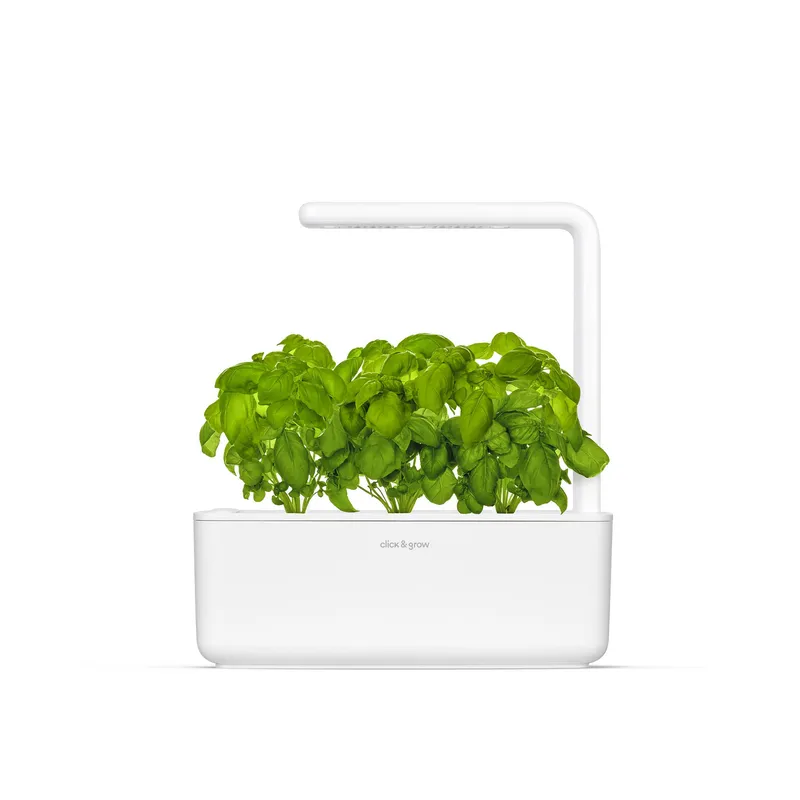
Click & Grow Smart Garden 3 — holds 3 pods in a footprint just under 12 inches wide, with automated watering, light, and nutrients, and 75+ pod varieties to choose from. The 1.5L water tank lasts roughly 2–3 weeks between refills. Smart Soil pods are proprietary — Click & Grow's own site compares the system to a capsule coffee machine, but for plants.
Mid-size — 6 pods
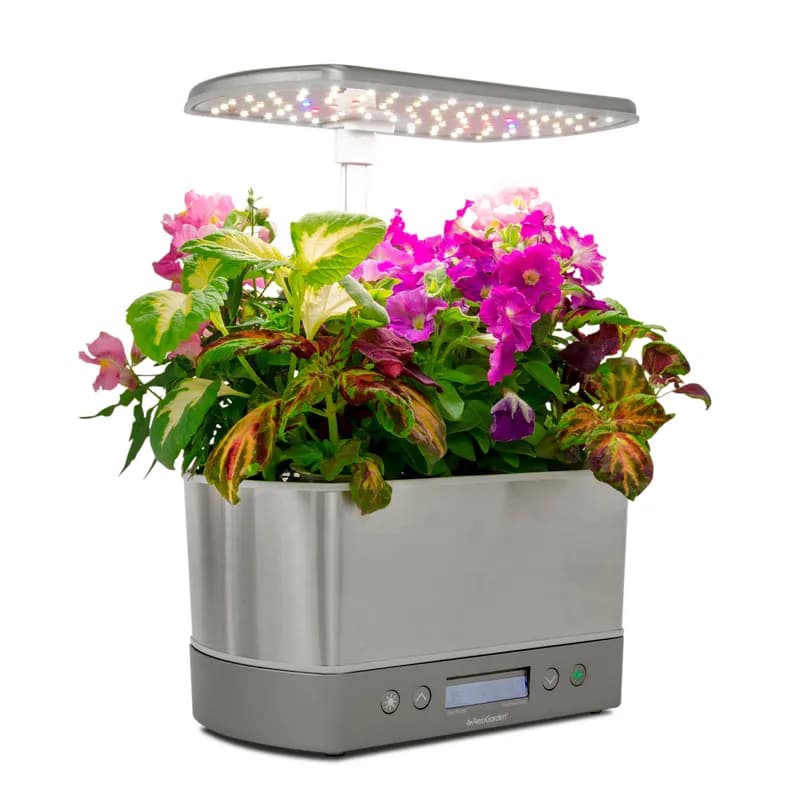
AeroGarden Harvest Elite Stainless Steel — a 6-pod capacity with a 20W full-spectrum LED grow light, automated water and plant-food reminders, vacation mode, and a grow height adjustable up to 12 inches. Seed pod kits are proprietary — the included 6-Pod kit only refills with AeroGarden's own pods.
Largest — 9 pods
AeroGarden Bounty — the largest AeroGarden here: 9-pod capacity, a 40W full-spectrum LED grow light, Wi-Fi with a full-color touchscreen control panel, and a grow height adjustable up to 24 inches for taller plants. Same proprietary pod system as the rest of the AeroGarden line, just bigger — 9 pods to keep restocking instead of 6.
Frequently asked questions
How many plant pods do I actually need? It depends on counter space and how much you want growing at once. Click & Grow's Smart Garden 3 holds 3 pods in a footprint under 12 inches wide, AeroGarden's Harvest Elite holds 6, and the Bounty holds 9 — each step up trades counter space for more plants growing at the same time.
Do I have to keep buying the manufacturer's own pods? For AeroGarden and Click & Grow, yes by default — both systems are built around their own pod formats. Click & Grow does sell a bring-your-own-seed option, but the default experience for both brands means restocking their own pods.
What's the actual difference between Kratky, DWC, and NFT? Kratky needs no pump — plants sit above a reservoir and it's the lowest-maintenance option, but it doesn't scale well to larger plants. DWC adds an air pump for constant oxygenation and grows faster, but needs continuous electricity. NFT circulates a thin nutrient film through sloped channels — efficient, but if the pump fails, plants dry out quickly.
Why does pH matter so much in a hydroponic system? Outside the optimal 5.5–6.5 range, plants can't absorb certain nutrients even when those nutrients are present in the solution. Symptoms can look fine for weeks and then suddenly show up as deficiency — pH is the maintenance step most beginners skip and the one that causes the most problems.
How much can a small hydroponic garden actually produce? A 2×2 ft system can realistically produce enough lettuce for a side salad every week or two — not a full grocery replacement. That's the honest scale of a home setup, not a flaw in the system.
How we evaluate
Picked by Ordis is a curated shop and independent guide for AI and smart-home gear built for the U.S. market. We weigh the things that actually decide whether an indoor hydroponic garden is worth owning — pod capacity relative to counter space, real LED wattage, water-tank capacity and refill cadence, and whether the pod system locks you into one brand — over marketing claims. For U.S. buyers we pay particular attention to domestic warehousing and honest return policies, because in the post-de-minimis landscape a device that ships from a U.S. warehouse with real support is worth more than a cheaper one stuck in customs.
This is an independent buyer's guide. When a product carries our "Vetted by Ordis" seal, it has met three specific checks — U.S. warehouse / domestic shipping, FCC compliance where applicable, and the seller's own return policy of at least 30 days. Nothing in this guide is claimed as vetted unless it shows that seal; the seal is reserved for products we've confirmed, not assumed.